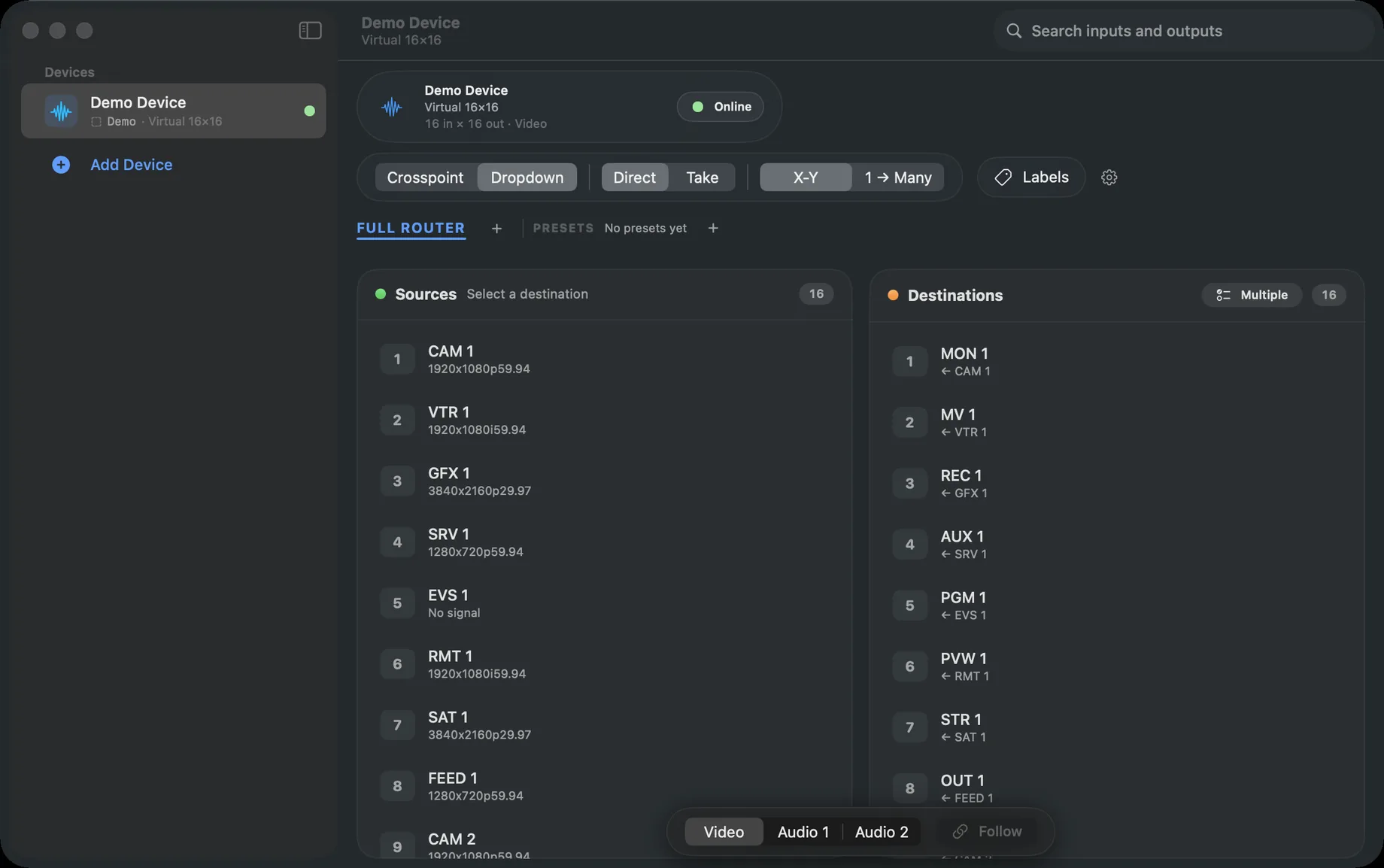
A working miniature of the router panel. Route from the crosspoint
grid or the Dropdown view, and switch to Take to stage changes and
cut them together — exactly as in the application.
Demo Router
Virtual 8×68 in × 6 out · Video
Online
The full application drives matrices up to 512×512 —
with pinned headers, zoom, search, locks, breakaway and live signal status.
Routing
The router, the way an operator expects it.
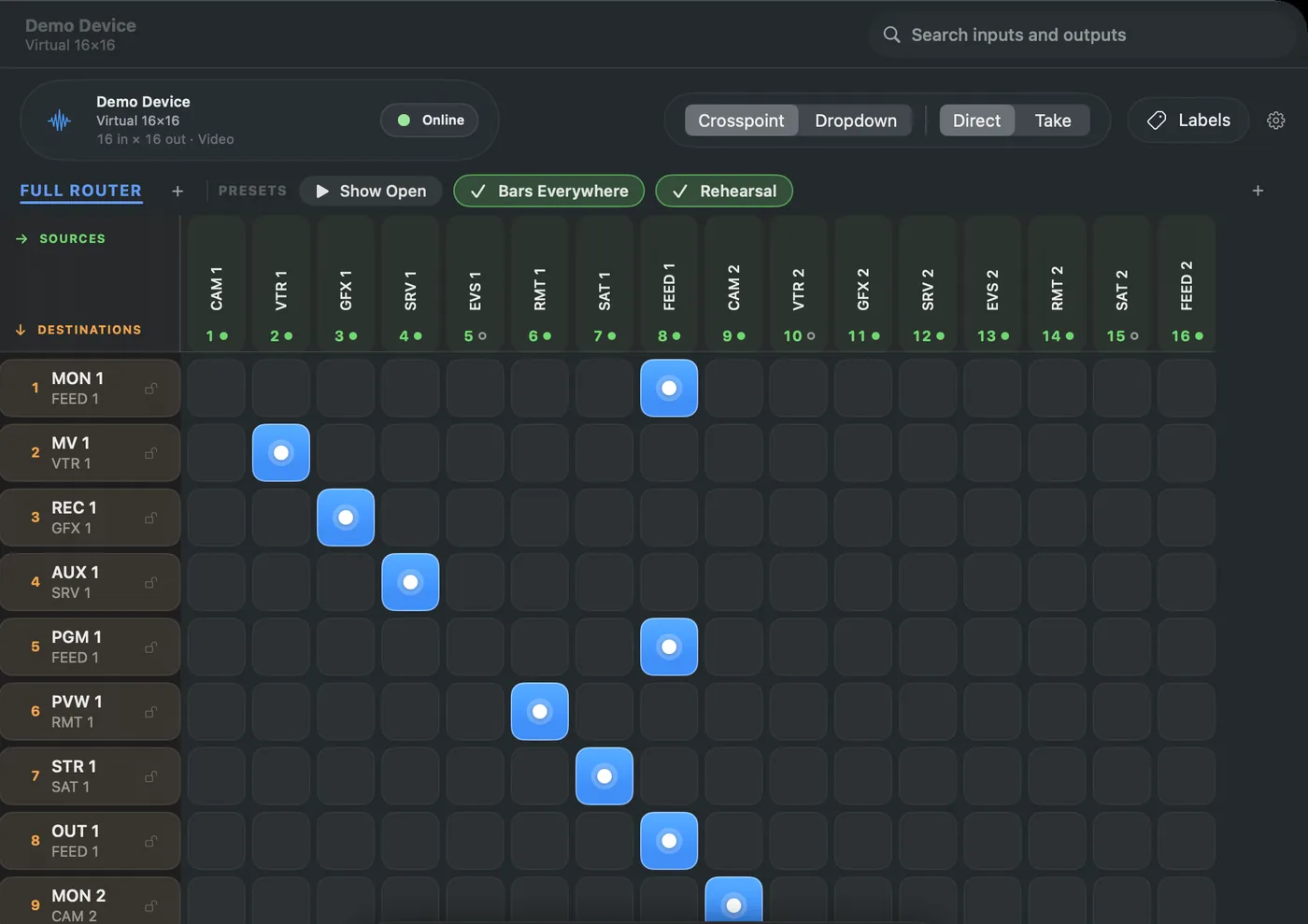
Crosspoint grid or X-Y Dropdown, Direct or Take, presets and
virtual panels — on any matrix from 12×12 to 512×512.
Direct or Take
Route instantly, or stage a set of changes and cut them together with one press.
Presets that show their state
A preset reads active while the router matches it, and shows the difference when it does not.
Locks that name the holder
A locked output says who locked it — this application, the hub itself, or another controller.
Virtual panels
Give each operator only the sources and destinations they need, with presets saved per panel.
Also on every router: search inputs and outputs from the toolbar,
1 → Many routing, labels, lock or unlock every output at once, Bonjour
discovery, and panels, presets and labels copied from another Mac on the network.
HyperDeck
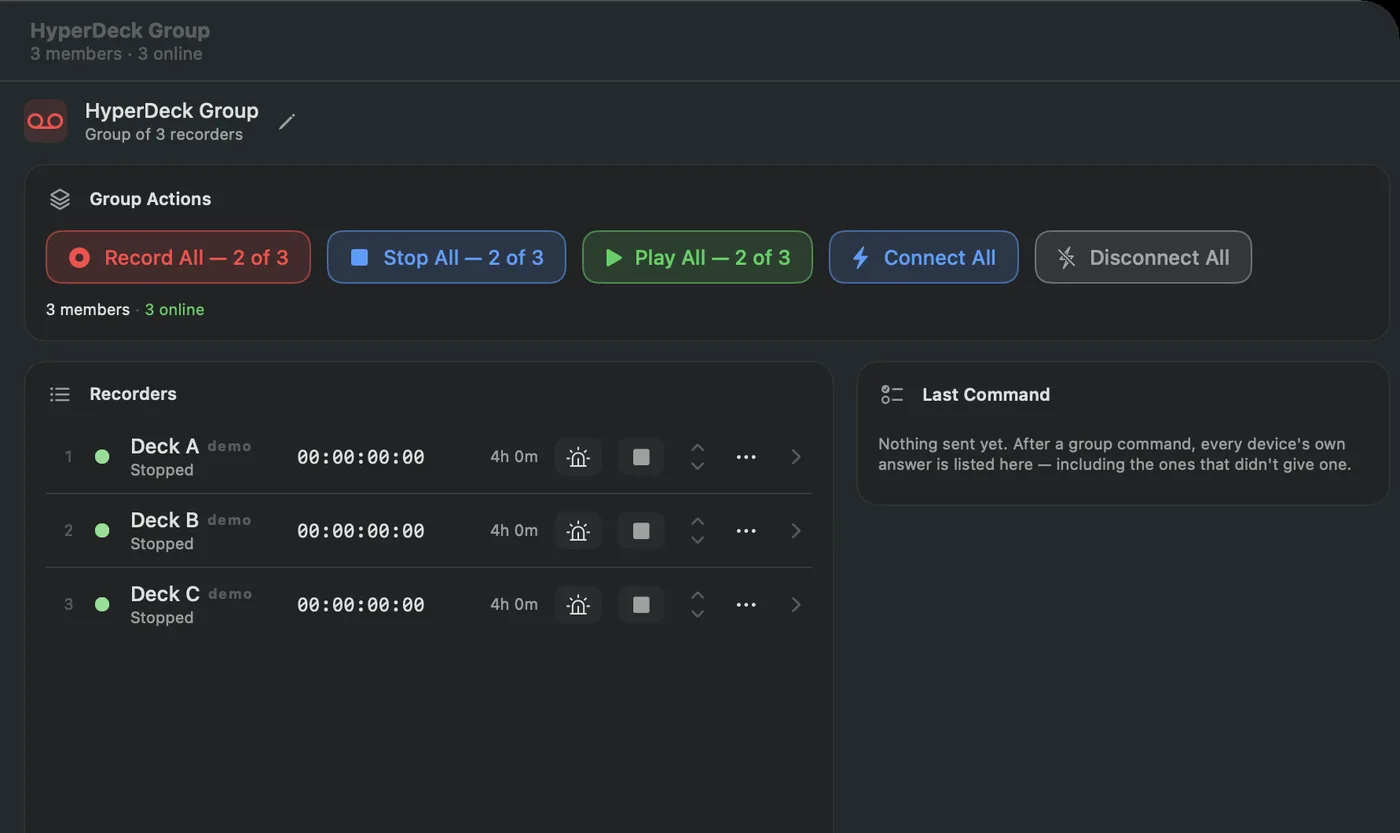
Every deck, one press — and proof of it.
Group your recorders and drive them together. Then copy the day's
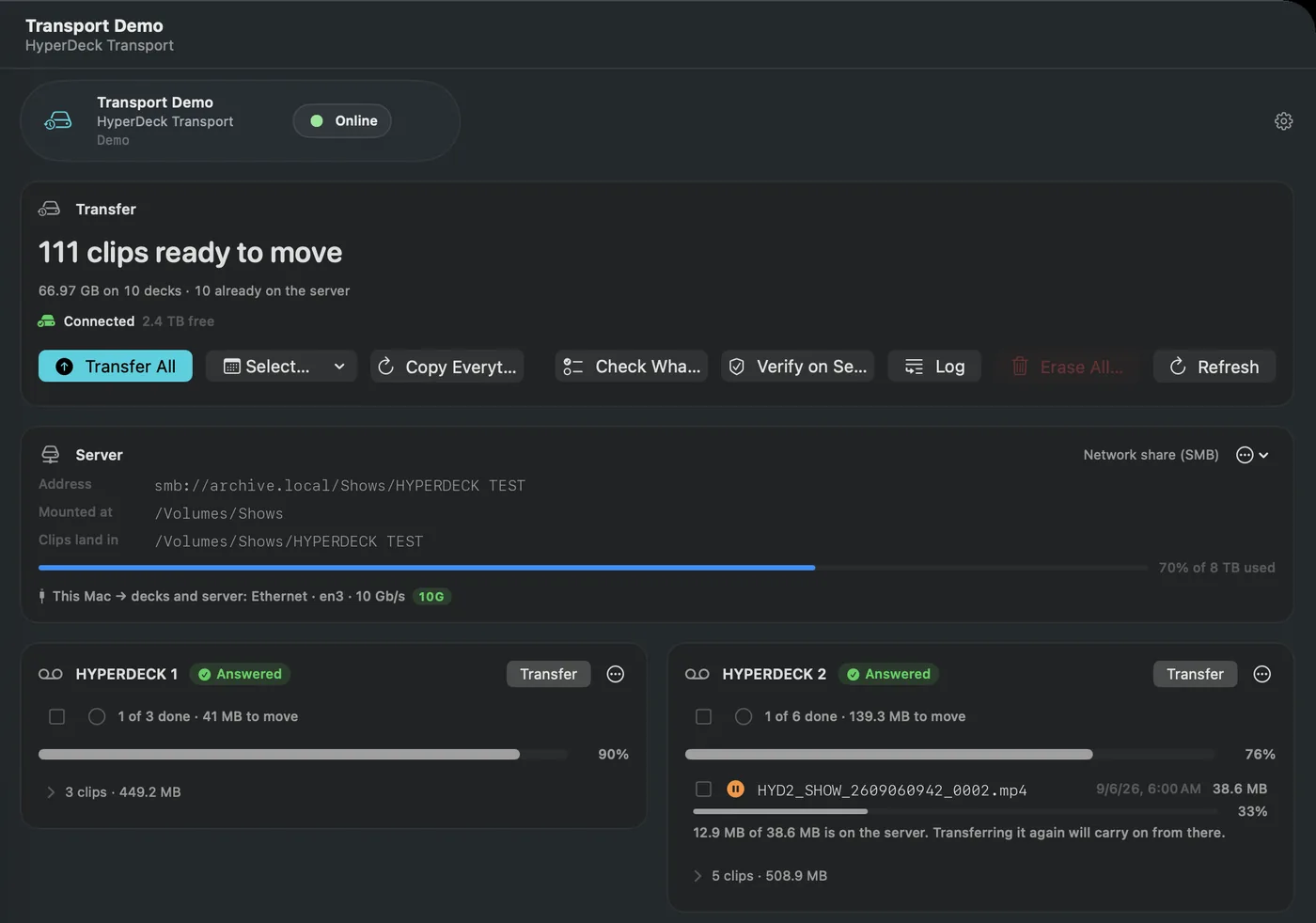
clips to the server, verified byte for byte, before a single card is erased.
REC01:02:14:0810 OF 10 ROLLING
Record All. Stop All. Reported per deck.
Every group command answers member by member. A deck that did not respond is never shown as recording, and offline units are named.
Identify
Flash a deck's own display from its row, so the box in the rack and the entry on screen are the same one.
Timecode that runs like a clock
Each deck's timecode on its row, and the group's shared timecode in the sidebar while the rack is in step.
The right unit, or held
Addresses move on a power cycle. An entry that answers as a different deck is held — nothing listed, nothing erased — until you accept it.
Offload to the server
Transport copies clips off up to ten decks at once to any share Finder can mount — SMB, AFP, NFS, FTP or WebDAV.
Verified by content
After a clip lands it is read back and checksummed against the deck's copy. Check What Landed runs itself when a transfer finishes.
Erase, only when it is safe
A deck is refused an erase until every clip on it is verified and it has proved it is the unit you mean. Nothing on the server is ever overwritten.
A Log for everything that fails
Every refused erase, dropped connection and failed check is kept with the deck's own answer, ready to copy.
01
Record
Roll the whole group from one button, with the answer from each deck.
● REC 10 of 10 · every deck answered
02
Copy
Pull the clips to the server, oldest first, resuming what was interrupted.
→ HPR-04 / clip0007.mov · landed beside, never over
03
Verify
Read every clip back and compare it with what the deck holds.
✓ 27 of 27 clips verified by checksum
04
Erase
Format the card only once the deck is confirmed and every clip is proven.
■ Slot 3 · exFAT · deck confirmed, timeline empty
Devices
Speaks your gear's language.
Native protocol implementations, straight to the hardware. No middleware,
no drivers to install.
Hardware
Protocol
Routers
Blackmagic Videohub
Videohub Ethernet · Bonjour discovery
Lightware MX2
LW3 — with live input signal & resolution
Ross Ultrix & SW-P-08 routers
Pro-Bel SW-P-08
Evertz & Quartz-compatible routers
Quartz Type-1
AJA KUMO
HTTP REST
Grass Valley · Utah Scientific · Imagine
Via their SW-P-08 / Quartz emulation modes*
Recorders & conversion
Blackmagic HyperDeck
HyperDeck Ethernet protocol · TCP
HyperDeck Transport
Clips to SMB · AFP · NFS · FTP · WebDAV
Blackmagic Teranex AV2
Teranex Ethernet protocol · TCP
Blackmagic UltraStudio & DeckLink
DeckLink API — local to this Mac
Switching & monitoring
Blackmagic ATEM switchers
ATEM protocol · UDP — including SuperSource
Blackmagic ATEM Constellation aux
Aux routing via Videohub protocol
Blackmagic MultiView 16
Videohub Ethernet — detected automatically
Cameras & lighting
PTZ cameras — PTZOptics · Sony · generic
VISCA over IP · TCP or UDP
Panasonic AW-RP & Sony RM-IP500 controllers
Panel selection drives Links & tally
DMX lighting
Art-Net 4 · unicast or broadcast
Custom
Custom devices
Raw TCP / UDP — user-defined commands
* Standard emulation modes offered by those platforms.
Principles
Built to be believed.
Live production depends on accurate state. Every surface in the
application follows the same three rules.
Reported, not assumed
Group actions answer device by device. Changes are confirmed by reading them back from the hardware, and a control outside a device's command set is disabled with the reason stated.
Guarded on air
Take stages changes behind an explicit confirmation. Locks protect critical outputs. ⌘Z reverses routing and configuration changes alike — never a destination modified since.
Rehearse first
A simulator for every device class, modelled on real hardware. A whole rig builds before the gear arrives and exports as one .rtrconfig file, previewed before import.
Put the control room on every desk.
Free while in beta. Download it and take control of the rig.